
Reply to Anton's "Fury Road"

I read Michael Anton’s review of my book, Furious Minds: The Making of the MAGA New Right, with interest—and a glass of whiskey. The review was published back in February, as bombs rained down on Iran and elsewhere in the Middle East in the early days of President Trump’s “Epic Fury” campaign. It was titled “Fury Road” and came out with the Claremont Review of Books. I have come to think of it as the Jane You Ignorant Slut of book reviews.
The CRB is the flagship publication of the Claremont Institute, which published the first intellectual defense of Trump in 2016. That was “The Flight 93 Election” essay, written by Anton but published under a pseudonym. ‘Flight 93’ was so extreme in its arguments and rhetoric that its publication was highly controversial at the time, even on the right, and in some quarters entirely discrediting. I’m not sure that the Claremonters have done themselves any favors by publishing this predictable—dare I say furious—screed.
In addition to being at the vanguard of intellectualized Trumpism, Anton was also a senior appointee in both Trump administrations, an early opponent of birthright citizenship, a key hype man for the supposed “Biden Coup” in 2020, and one of the lead authors of America’s current national security strategy report. So Anton figures prominently in Furious Minds. I am not surprised that it made him angry. But his thin-skinned review only leaves him further exposed. It is chock-full of easily-proven falsehoods and misrepresentations, as well as failed attempts at psychologizing. On the whole, “Fury Road” reveals someone who cares more about winning an argument than about reality, and who assumes that real, lasting political victories can come without regard to the truth about the world.
Anton does his best to discredit me. He calls Furious Minds an “info op,” lists the typos and minor mistakes that he found (these things happen, as “Adrienne Vermeule” can attest). He plucks up lines from the book and pretends that they represent the full scope and tenor of what I wrote, drums up ad hominems, complains about my using the word “Claremonter,” and pretends that Harvey and Anna Mansfield need to be defended from that “catty” Laura Field.
What he can’t do is erase the record that Furious Minds provides of the movement that he started, nor can he destroy the book’s growing acceptance as a useful resource: The reviews are in and they are pretty good (even Rod Dreher didn’t seem to hate it). That is awkward for Anton and the Claremont Institute because the record my book provides is not always flattering—and not just when it comes to trifling matters but also including things that the Claremonters purport to care about most deeply.
It seemed to me like a good idea to lay out these problems more fully. Perhaps the folks at the CRB will consider issuing some corrections, or a retraction.
Anton Betrays the Spirit of Lincoln
My book was born of an article, “What the Hell Happened to the Claremont Institute,” that was first published at the Bulwark in 2021. I have published an article at the Bulwark touching on what I take to be the most consequential example of Anton’s duplicity. It concerns an essay that Anton wrote called “Toward a Sensible, Coherent Trumpism” and a passage from a speech Abraham Lincoln gave about the Dred Scott ruling. Anton manipulates a beautiful passage from Lincoln about the meaning of the Declaration of Independence. In my book I explain how that makes for a gross, sophistical distortion of Lincoln’s words. Anton took issue with my claim, and in his review he doubles down. You can read more about this dispute over at the Bulwark. The upshot is that Anton seems embarrassed by a passage from Lincoln that Harry Jaffa, in his most important book, likened to scripture.
Anton’s review is full of misrepresentations (or lies)
Then there are all the smaller—but more easily demonstrated—mistakes. Anton’s review contains numerous gross misrepresentations of fact or outright lies about the contents of my book. Here are some examples.
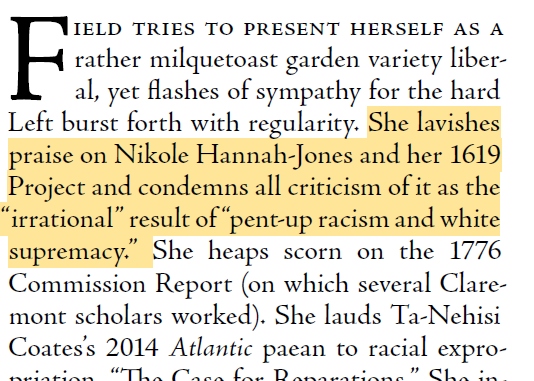
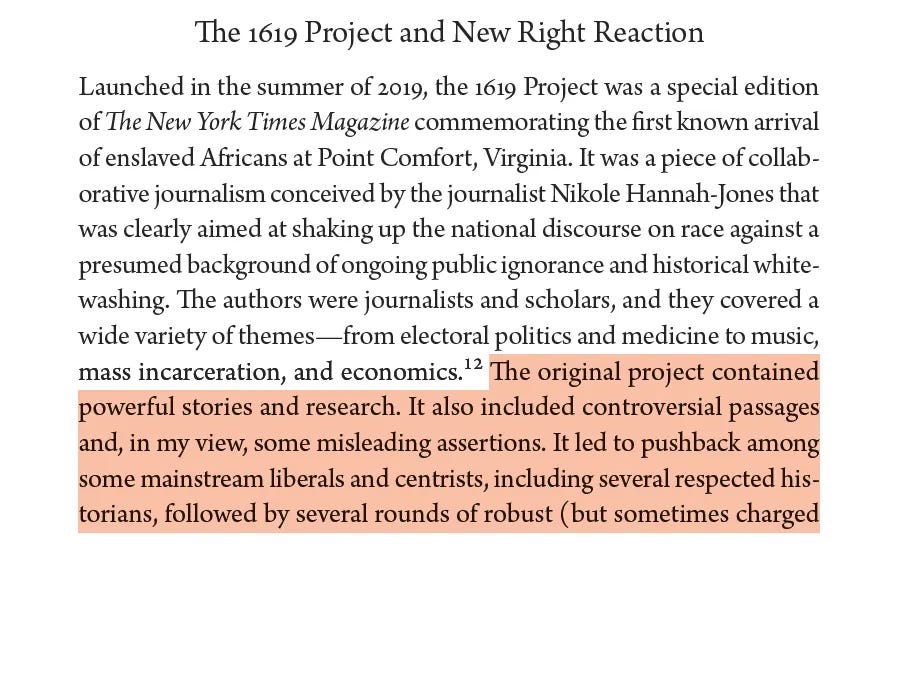
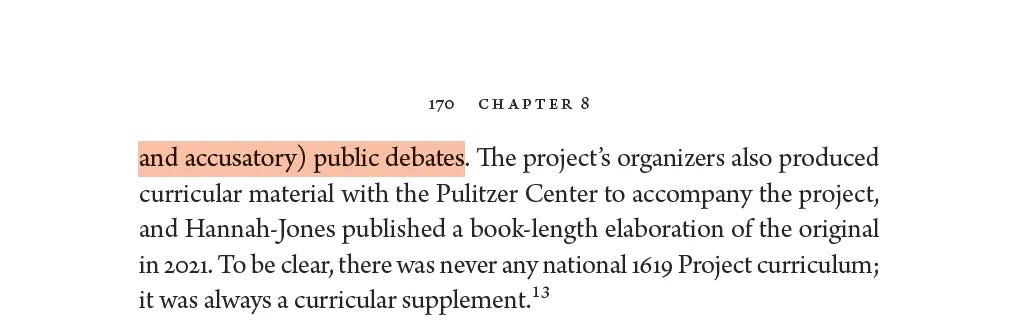
Anton misrepresents or lies about what I say about the 1619 Project
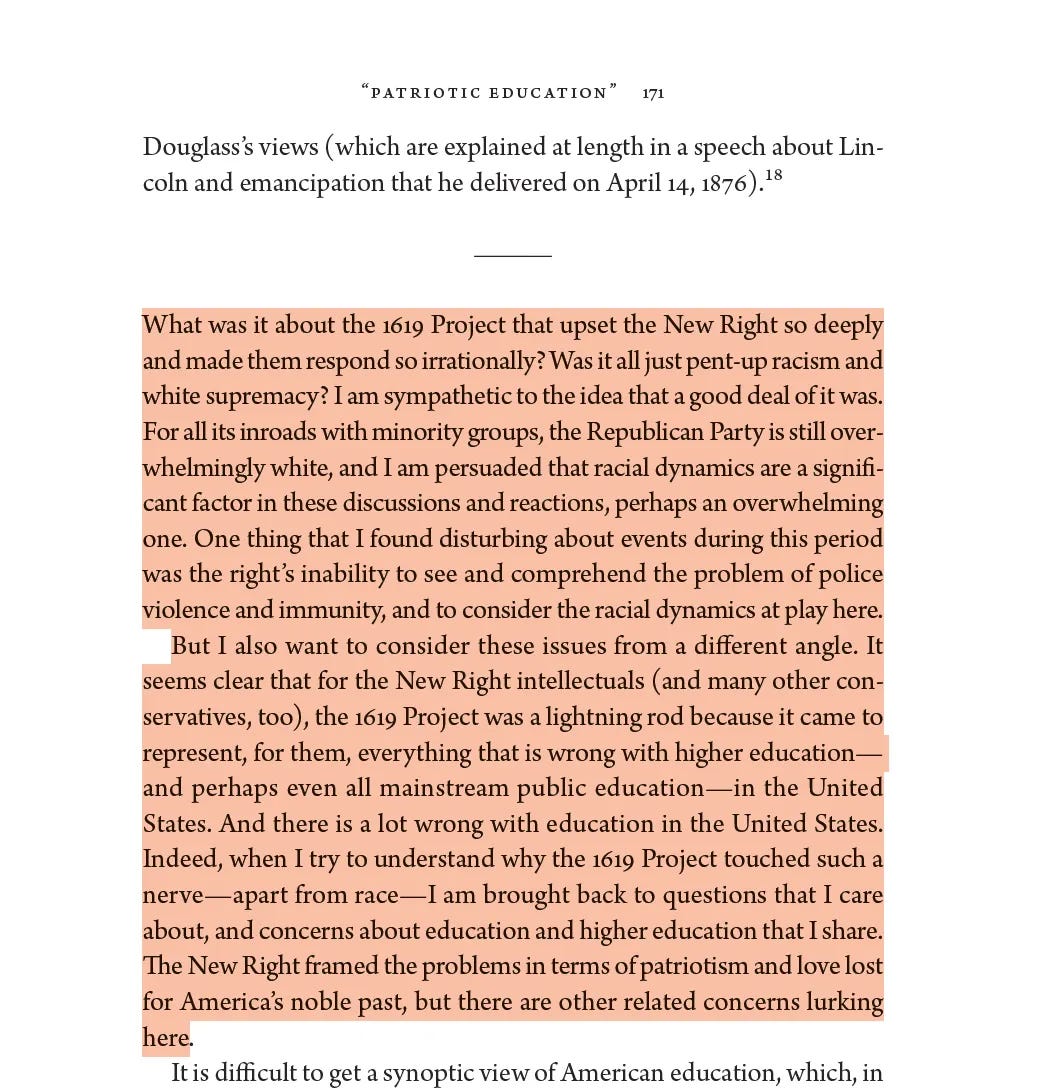
Anton says that I lavish praise on the 1619 project and condemn all criticism of it as racist and irrational. That is not accurate, at all. As I note in the book, I agreed with some of the criticism. I also spend some 5-6 pages (pp. 171-176) giving voice to some of the legitimate, non-racist frustrations that I believe help explain the right’s response to the 1619 Project (and that are fueling right-wing attacks on higher education).
Anton misrepresents or lies about what I say about the Black Lives Matter movement
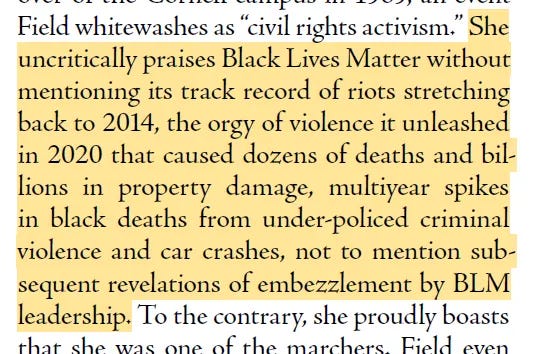
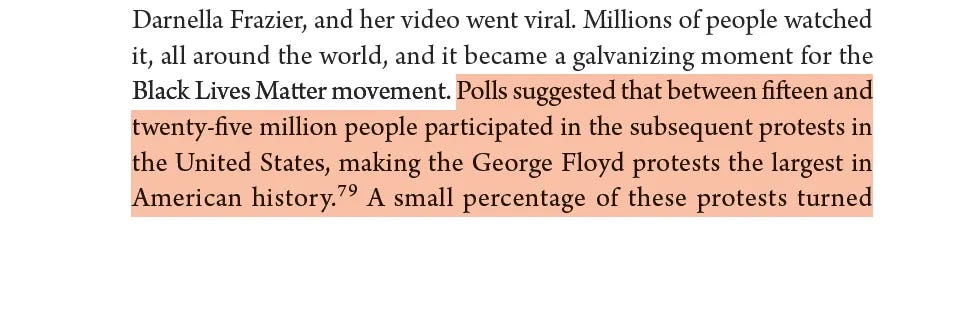
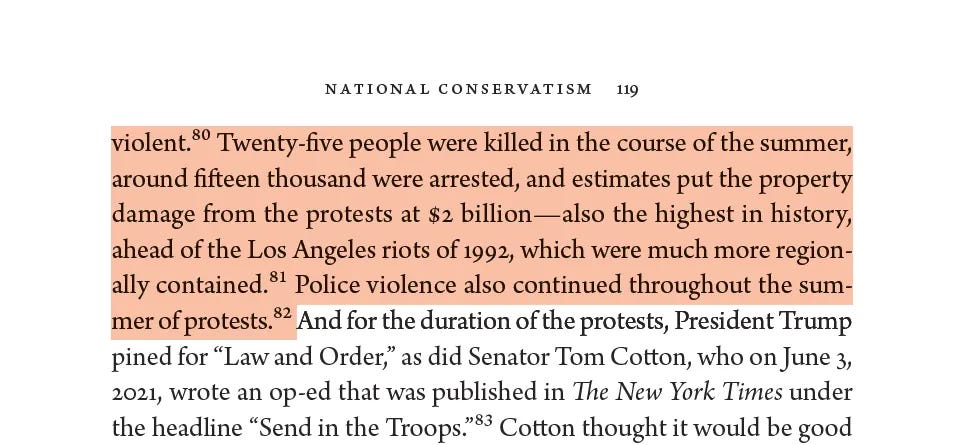
He says I don’t acknowledge the violence of the George Floyd riots, but I did.
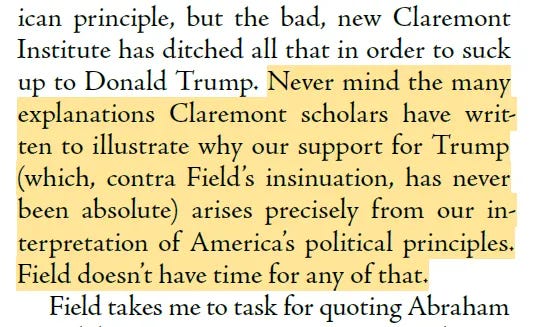
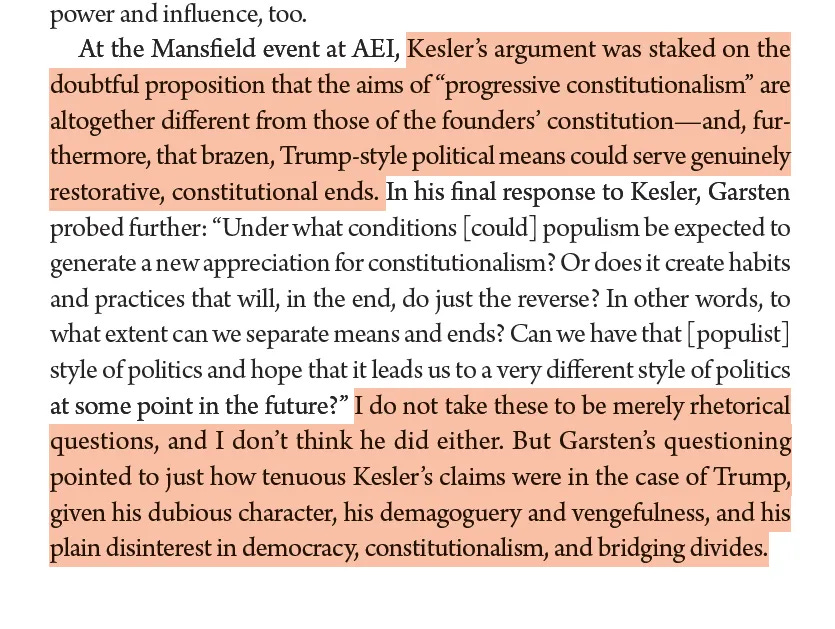
Anton misunderstands or lies about what I say about “Claremont Scholars”
He says that I fail to discuss the fact that they understand themselves to be acting in service of America’s political principles, but I address that claim repeatedly throughout the book (see, for example, pp. 162-163, subsection “The Claremont Way”). I also take up the argument, as voiced by Kesler, explicitly in the book’s conclusion.
Anton misunderstands or lies when he writes that I offer no concessions to the New Right
He writes: “Nowhere does she concede that Trump, his voters, or the figures she excoriates have a point about anything, any legitimate grievances, or any reason to be dissatisfied with the way things have been going over the past 30 or so years.”
On this point, I could prove Anton a liar, or a fantasist, or just a terrible reader, a dozen times over. The main purpose of Furious Minds is to provide a chronicle and record of what the New Right believes and why, so much of the time I am quoting directly from New Right figures. But while I make no pretense of agreeing with them when I don’t, I also make concessions of precisely the kind Anton demands throughout Furious Minds. I risk real tediousness if I try list these here (cue Brandolini’s Law). But as I’ve already noted, I devote a lot of my chapter on “Patriotic Education” trying in good faith to give voice to some of the legitimate criticisms that the New Right has of higher education. But a few other examples from the final chapters: I write sympathetically about elements of the MAHA movement in my chapter called “The End of Men,” note repeatedly that Christopher Rufo has some good arguments about the vulnerabilities of liberalism and liberals’ failures to articulate the purposes of our institutions, and argue at length in chapter 12 that the Christian Nationalists have better arguments than the liberals think they do. There’s even a handy little list of policy ideas I would borrow from the New Right tucked into the conclusion (see below, and 320-322).
Anton is incapable of distinguishing disagreement and criticism from an attempt at persecution
Anton’s most flagrant misrepresentation or lie about my work comes toward the end of his review. Here’s what he says:
Though Field never spells it out, it’s clear enough what she thinks should come next. Anyone associated with Trump, Trumpism, populism, nationalism, immigration restriction, opposition to DEI or racial preferences, anyone in favor of a more robust presence of religion in American life or anything even glancingly resembling the pre-sexual revolution family—these people and their ideas must be absolutely excluded from any influence on, or participation in, American public life. That this category covers at least a third, and perhaps more than half, of the American people does not seem to give her any pause.”
I cannot resist noting that this remark is, let us say, droll, coming from the author of Flight 93 and defender of Glenn Ellmers (who actually has made the repulsive argument “that most people living in the United States today—certainly more than half—are not Americans in any meaningful sense of the term”). When it comes to my views, Anton gets it entirely, badly wrong. And it’s not just that I “never spell it out,” it’s that I explicitly defend exactly the opposite. After conceding that liberals have a “soft despotism” problem, I write:
It is not a general problem but a rather narrow one having mainly to do with insular academics and elites. Whatever we call it, when it comes to this subset, conservatives who complain about liberal intolerance have a point. If deep moral pluralism is to be a modern liberal aspiration—and I think it must be—then all liberals must cultivate a hardened but steadfast toleration for worldviews that we find incomprehensible, deeply offensive, or dangerous. We do not have to like it, and we do not have to be sweet—as Sarah Schulman has written, “conflict is not abuse”—but we must do it, as a matter of intellectual integrity, a guard against the tyrannical drives that lurk within, and a pledge of humility and hope for a truly diverse future. Maximal accommodation for different outlooks should be our watchword; curiosity is a good one, too.
In that vein, there are many things to be learned from the New Right. If I were to play Athena in the unfolding drama of our age, and was in a magnanimous mood, I would ask Americans to think about the ways in which the New Right intellectuals have succeeded in shaking up the status quo—on economics, trade, localism, technocracy and managerialism, campus silos and campus bureaucracies, and the crisis of masculinity to which the entire New Right movement is such a loud testament. These are all areas where Americans could learn from one another across political divides, and in some cases they already have. The mistake here would not be listening too much; it would be to fall for the New Right’s Schmittian filth about friends and enemies and America being irreparably divided.
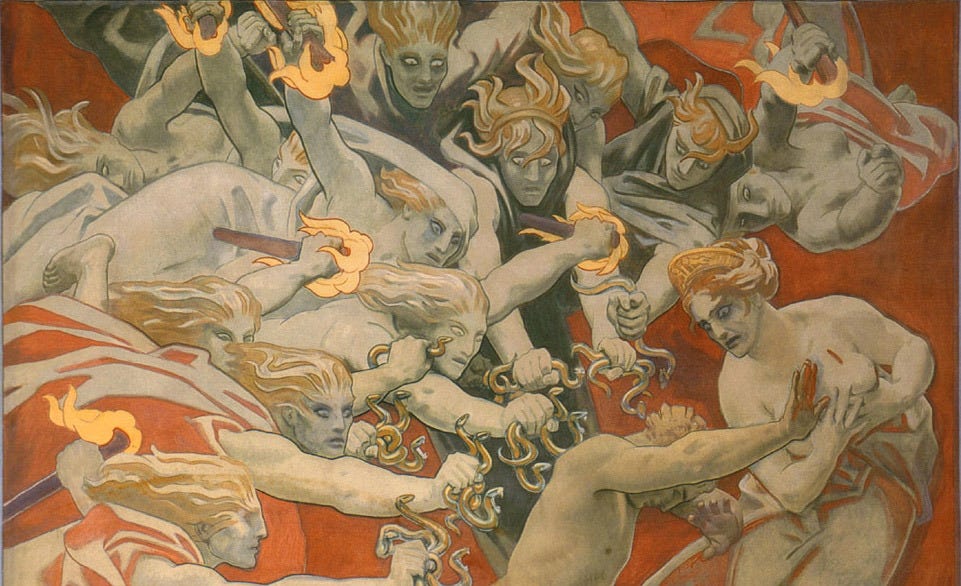
For those who, perhaps like Anton, haven’t read my book, my reference here is to the ancient goddess Athena as she is represented in Aeschylus’ Oresteia trilogy. My conclusion involves an analogy between the “Furious Minds” of the New Right and the ancient furies, who were earthly goddesses of vengeance, and defenders of traditional blood ties. In the Oresteia, Aeschylus presents the goddesses in highly sympathetic terms, and the final play involves a showdown between the fickle, detached, and sometimes cruel Olympian gods, who I liken to liberals, and these other ancient deities. In the end, Aeschylus uses Athena to reconcile the angry furies with the newer gods by offering them a new perch and place of respect in the city. In Furious Minds, after listing a whole series of policy ideas from the New Right that I think are good, I end up recommending nice new jobs for (most of) the thinkers of the New Right. Contra Anton, I don’t think they are “evil” or want them ousted from civil society—I want them installed as co-directors of new institutions of higher education devoted to the humanities!
Anton’s claim that I stand against half the country is nonsense. By 2024, given the haplessness of the Democrats and the (shameful) fact that President Biden ran again, I found it pretty easy to understand Trump voters. My book is about a narrow and elite slice of MAGA—people I believe to be considerably more radical than the base.
Anton is a Bad Psychologist
One part of Anton’s review that is genuinely funny to me is his attempt to perform Straussian psychoanalysis on yours truly. He accuses me of being an angry moralist while couching that anger in the language of sorrow, and he also suggests that I am a cynical amoral East Coast Straussian who doesn’t really believe in virtue or morality:
The Eastern Straussian world from which Field emerged criticizes Claremont not merely for our alleged misunderstanding of America but for (allegedly) misapprehending the entire philosophic tradition. Although it is true, these critics concede, that the tradition speaks of virtue, morality, ethics, justice and injustice, right and wrong, teleology, etc., Claremont misses or willfully ignores the all-important clues that all that is just exoteric cover. Whether our misunderstanding arises from limited intelligence, moralistic zeal, or a psychological need to believe in life-affirming myths is immaterial. The upshot is the same: we just don’t get it.
This assessment is comical, and I imagine would be funny to anyone who knew me back when or knows me now. I truly did not mean to play such a sphinx, and while it is good of Anton to try to school me in all that, he has wasted his breath. The truth is that I’m not an East Coast Straussian, largely because, more like the Claremonsters, I care about politics too much and am not a cynic about morality. I basically agree with Anton’s account of the reality of morality and need for virtue as he has articulated it in his review of my book. I just apparently disagree with him about the actual character of the virtues (and their relationship to truth) and about whether liberals and non-MAGA people can partake in them—something I discuss in the conclusion to Furious Minds.
As for Anton’s claim that I am seething with anger, I admit that at times as I worked on Furious Minds, and on this response to his review, I have experienced waves of anger. But it hasn’t been too bad. One of the many good things that I did take away from my East Coast teachers is a good Socratic lesson about the dubious character of anger and its pernicious effects on the soul longterm. Anger can certainly be a useful signal about justice and injustice in the world, and about truth and lies. But it also tends to corrupt, not heighten, judgment, and it’s better to tame it than indulge it. One thing they don’t tell you in Straussian school is that at some point in your journey into free adulthood it is ok to arrive at a judgment about a writer and to stop reading. At some point in writing my book, I admit, I did that with Anton, and with Ellmers, and with Jaffa, too, as there was a lot of other material to cover.
I should also admit, however, that Anton has made my book more vulnerable to criticism, though perhaps not in the way that he intended. The premise of Furious Minds is that the New Right is worth taking seriously—and that even people who disagree with them need to work to understand their ideas and their anger, because many of these thinkers are smart, perceptive, and interesting. Believe it or not, that is a counterintuitive claim to many Americans—from the far left to the Never Trumpers, and certainly including most of academia—and I find their smugness and condescension annoying. But Anton’s review suggests I may have been overstating my case all along. The joke’s on us both, I guess.
One Last Thing
One final note. Anton uses the epigraph of my book — a quote from Clive James — as proof that I think he and his fellow travelers on the New Right are “heirs of the Final Solution.” He claims, in the course of a 7,500 word review, that there isn’t room to quote the epigraph, but I say readers deserve to judge for themselves:
The idea that it takes extreme experience to produce great literature should never be left unexamined. The great literature that arises from extreme experience covers a very narrow band, and does so at the cost of bleaching out almost the whole of life—the everyday world that enjoys, in Nadezhda Mandelstam’s great phrase, “the privilege of ordinary heartbreaks.” Catastrophes like the Holocaust—and if it is argued that there have been no catastrophes quite like the Holocaust it can’t usefully be argued that there won’t be—have no redeeming features. Any good that comes out of them belongs not to them but to the world they try to wreck. Our only legitimate consolation is that, although they loom large in the long perspectives of history, history would have no long perspectives if human beings were not, in the aggregate, more creative than destructive. But the mass slaughter of the innocent is not a civics lesson. It involves us all, except that some of us were lucky enough not to be there. The best reason for trying to lead a fruitful life is that we are living on borrowed time.
Anton says that the upshot of this quote is that ideas and writings led to the Holocaust, and that today there is a parallel danger coming from the New Right. That is not the meaning of this passage, which is about the nature of literary production, the moral valence of historical catastrophe, and only incidentally about the ways in which sophisticated, literary people sometimes justify or make excuses for gross political violence. To be clear: I do not think that literary people are primarily responsible for the Holocaust (or, for that matter, for Stalinism). But the grandiose style that James describes is certainly part of the New Right mix, and I have been drawn to similar themes in the past—arguments, say, about the Last Man and the Ubermensh, or about the failure of liberalism and the need for regime change, or about the Antichrist and the Katechon.
Anton recognizes this. What he misses with his bad-faith histrionics is that the intent of my epigraph was to invoke, broadly, the anti-catastrophic liberal humanism that animates Clive James. James’ paragraph is best understood as a warning against a certain habit of mind: the romanticization of the politics of reaction and extremity. Radicalism is perpetually alluring, glamorous, titillating. But apocalyptic politics and revolution are almost never as clarifying, regenerative, or profound as its purveyors imagine them to be beforehand. And no matter how boring, bourgeois, bureaucratic, or decadent one might find life under contemporary liberalism, contempt for liberal ordinariness isn’t justified.
Still, to call the New Right out for their naivete and recklessness is not the same as announcing that they will be the ones standing at the gas chamber doors. It seems to me that extremism and suffering will always be with us; they need no boosters. What we need are people tethered to the real world, who care about their fellow-citizens, and share with them a sense of human decency. That’s why I admire and constantly return to Abraham Lincoln, who acted humanely for reasons that were real. It is also why I believe in the untold value of “ordinary heartbreaks” and of modernity’s so-called “low but solid ground.”
That was what I meant to convey with the epigraph.
Thank you for this. I can only imagine how hard it must be to be interacting in this world of fury. I have respect for you writing your book Furious Minds. It is an incredible source to understand what is happening now in the US came from. You write in this post "Anton’s claim that I stand against half the country is nonsense." that is nonsense, but I feel they do exactly that. They, in this regard are the people who agree with what is being done by this current US regime. These people do not take criticism very well. They are the ultimate victim, even in victory. That alone proves to me that they are wrong in their view of the real world.